
Indian's Nose - Lake Atitlan
The Indian’s Nose viewpoint sits at at 2,863 meters looking over the pueblos of San Pedro, Santa Clara and San Marcos. Its name comes from the fact the profile of the mountain looks like a sleeping Indian with the viewpoint as its nose. The hike is 1.5 to 2 hours of a very steep climb. Definietly worth it though!
While visiting San Pedro for a few days I found out about a moderate hike to see the sunrise over the lake. San Pedro is one of the larger towns located on Lake Atitlan and is known as a party town. This doesn’t stop the travel agencies from selling volcano treks to the nearby volcano and the shorter but steeper hike to Indian’s Nose.
The Indian’s Nose viewpoint sits at at 2,863 meters looking over the pueblos of San Pedro, Santa Clara and San Marcos. Its name comes from the fact the profile of the mountain looks like a sleeping Indian with the viewpoint as its nose. The hike is 1.5 to 2 hours of a very steep climb.
While I was doing my research on how to get there and whether I should do guide or no guide, I found out about an expat called Matt Purvis who is a geologist and runs specialist tours up to the lookout and around the area. Matt has a B.S.c. in Geology and an M.S.c. in The Science of Natural Hazards and the selling point of his tour is that you can learn all about how the area was formed and the unique history that makes up the region.

You can do this hike at any time of the day but the most rewarding time is early in the morning so you can see the sunrise. Worthy goal but we did have to get up at 3:30 am. I was more than happy to head to bed early to get some sleep but unfortunately we were staying in a bit of a party hostel. Picture me brushing my teeth in my pyjamas at 8 pm in the sink that is next to the bar declining offers for “just one more drink!"
I managed to convince one of my new travel friends, Laura, to do the hike with me but had some trouble waking her up the next morning. Why can’t everyone be a morning person like me?
Our guide, Matt, was full of energy when he arrived, while a few of the group looked worse for wear, myself included. I had woken up feeling dreadful and wasn’t sure my stomach was going to survive the hike. I didn't know if whatever was going on in there wanted to go up or down and I think it hadn’t made its mind up yet.
The worst part was while they were feeling ill because they had stayed up partying all night, I was genuinely unwell. I didn’t want to be lumped into the hungover category! To avoid this I was determined to get up that mountain and not make a word of complaint on the hike up.

Once we had the whole group together we headed to the chicken bus stop up the steep hill in San Pedro. Challenge #1 completed!
Challenge #2 was the chicken bus ride to the trailhead and after a few close calls, I managed to keep my small breakfast down.
The group gathered at the trailhead where Matt and his two local guides handed out flashlights. These were absolutely necessary because the trail is completely dark and quite slippery in some points.
We set off on some relatively flat terrain while navigating through the back of the town until we hit the start of the steepest hike I’ve ever done. For about an hour I climbed up the side of the mountain while simultaneously holding down my breakfast and praying that it wasn’t going to try to come out in a hurry through the other end.
I struggled to make it all the way to the top, determined to not look like a whingey baby and even tough I was one of the last people up there I was pleased to see the top. Matt and his guides has built a fire to help warm us up while we waited for the sun rise but after getting a few whiffs of the smoke I promptly threw up off the side and into the poor bushes.
The good news was I felt completely fine after that, I just wish it had happened earlier! I also got to experience the sunrise without feeling awful.

Success!
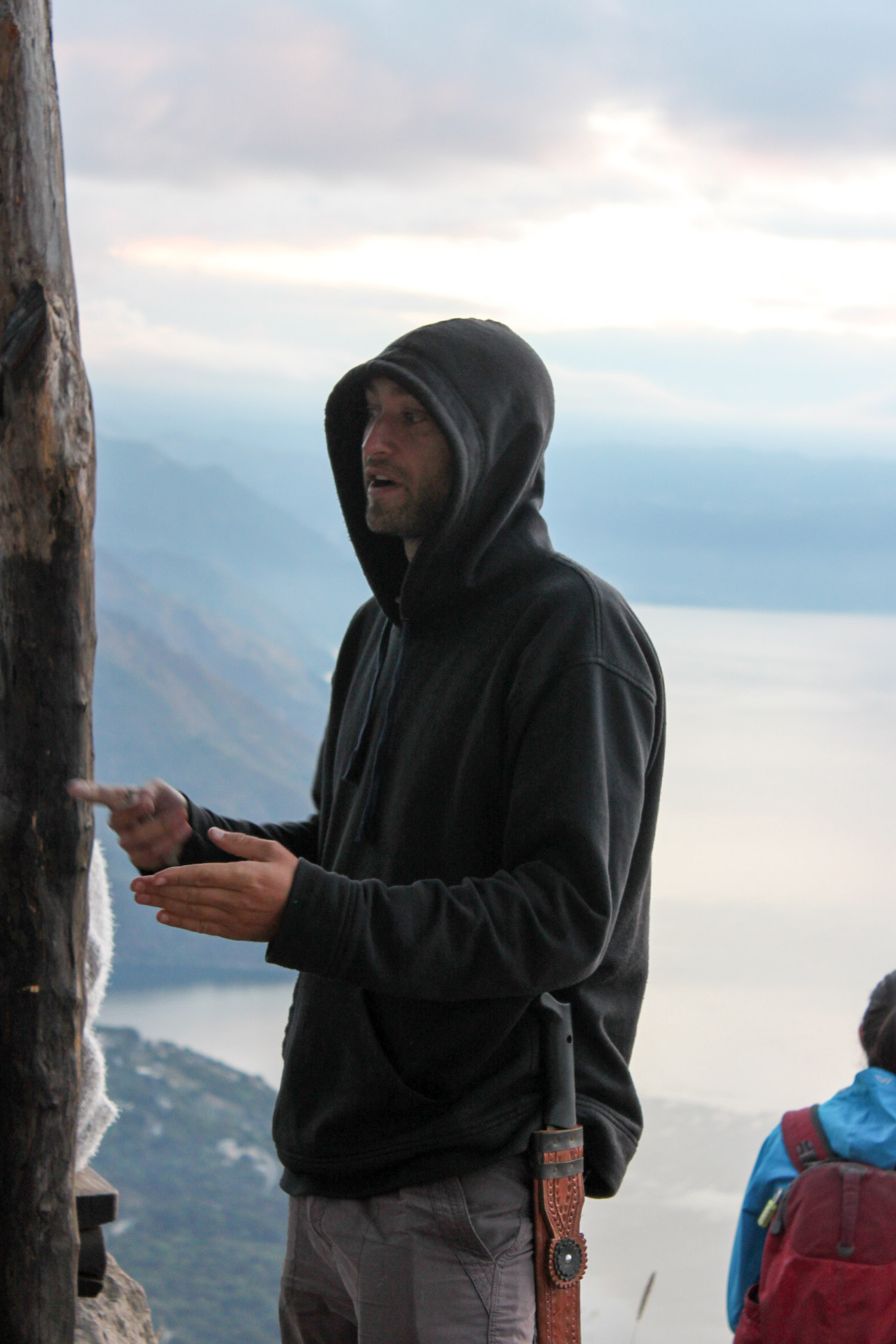
Once we had some coffee and a light breakfast and soaked in as much of the view as we could handle, Matt gathered the group together to go through his mini geology lesson.
From Indian’s Nose you can spot the 8 volcanoes of the region. Matt explained how they came to stand in a line and how Lake Atitlán was formed. He spent about 20 minutes going through the basics of volcano formation and the unique history of the region complete with diagrams and makeshift drawings in the dirt.

Lake Atitlan fills the Atitlan caldera, a huge hole in the ground caused by a massive volcanic eruption 85,000 years ago. The eruption has been named the Los Chocoyos event after the birds that now burrow nest holes into the extensive deposits.
To help bring the size of Los Chocoyos into perspective compare it with the eruption of some modern day volcanoes. When Mt. St. Helens in the US blew up in 1980, one cubic kilometre (1km3) of rock, lava and ash shot from the volcano. This seems small compared with the 1991 eruption of Mt. Pinatubo in the Philippines, which ejected around 10 km3 of magma, the largest in living memory.
These modern eruptions are dwarfed, however, by Los Chocoyos 85,000 years ago. A total of 270km3 of volcanic debris was thrown out of the caldera, covering Guatemala with ash and rock.
Ash from the Atitlan caldera can be found in the rock strata as far north as Florida and as far South as Panama and most of Central America would have experienced a darkening of the skies as the ash rose into the atmosphere. Crazy interesting right?

After his talk, we headed back down the mountain but via different path so we could experience a different viewpoint. We got to walk through some local maize fields and coffee plantations where one of the local guides also taught us about local medicinal practices and the interesting division of land. The parents divide the land up amongst their children and the children continue the tradition. What was once a large plot of land has now become many smaller plots.
I highly recommend hiking Indian’s Nose when you’re in the area and if you have the opportunity go through Matt! Hiking is so much more fun when you get to learn something new and unique to the area that you’re in.
“Matt Purvis
geotravelguatemala@gmail.com
+502 3168 8625”

What to take
- Definitely take a flashlight. Your guide might offer one or if you have a head torch, even better. It gets really dark on that trail.
- Wear some good shoes. Hiking shoes if you have them but anything enclosed is best. It can be slippery even just from the dew at that time in the morning so no flip flops.
- Wear layers. If you’re doing the sunrise hike then it will start off cold but that see hike will have you warmed up before you know it.
- A poncho in case of rain.
- Enough water, at least 1 litre.
- Some food for the top
- Have you ever had a tough hike that you almost couldn't finish?

You Might Also Like


Laguna Bacalar - The Lagoon of 7 Colours
The town of Bacalar and Laguna Bacalar itself are popular amongst budget travelers and backpackers but due to its remote location and importantly, the distance from Cancun Airport, it’s one of the least touristy places you can visit this close to the Caribbean Coast of Mexico.
I visited Bacalar on a two week trip with my family with a goal to show them what I love about Mexico away from the margaritas and novelty sombreros of the Mexican Riviera. Although there’s nothing wrong with those things, I really wanted to show them another side of Mexico.
The town of Bacalar and Laguna Bacalar itself are popular amongst budget travelers and backpackers but due to its remote location and importantly, the distance from Cancun Airport, it’s one of the least touristy places you can visit this close to the Caribbean Coast of Mexico.
Gaspar Pacheco founded the town in 1545 as Salamanca de Bacalar, derived from the Mayan words ‘Bak Halal’, meaning ‘place surrounded by reeds.'
I visited Bacalar on a two week trip with my family with a goal to show them what I love about Mexico away from the margaritas and novelty sombreros of the Mexican Riviera, and the extremely cultural but sometimes chaotic neighbourhoods of Mexico City. Although there’s nothing wrong with those things, I really wanted to show them another side of Mexico.
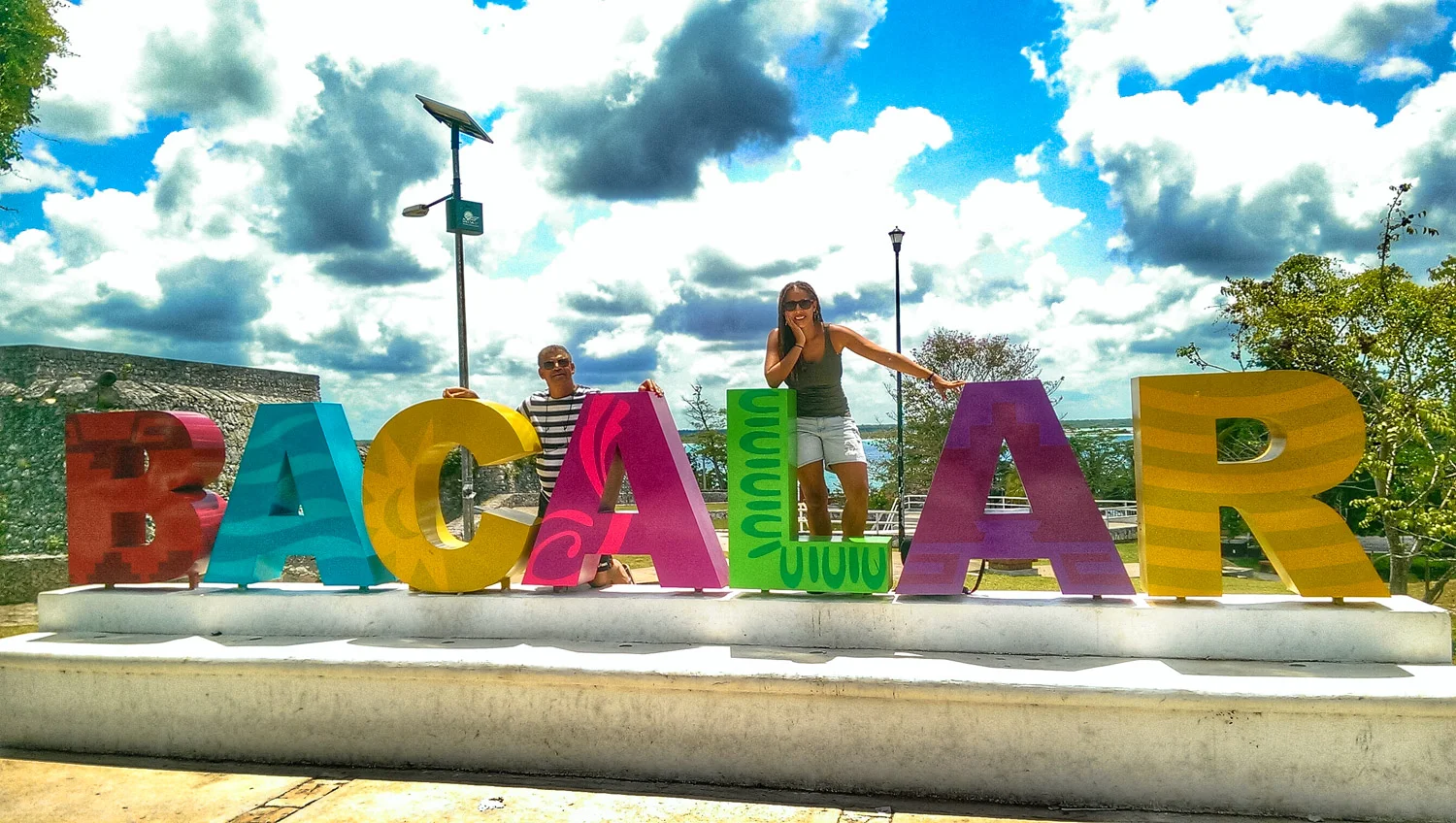
Fun with dad and the Bacalar sign
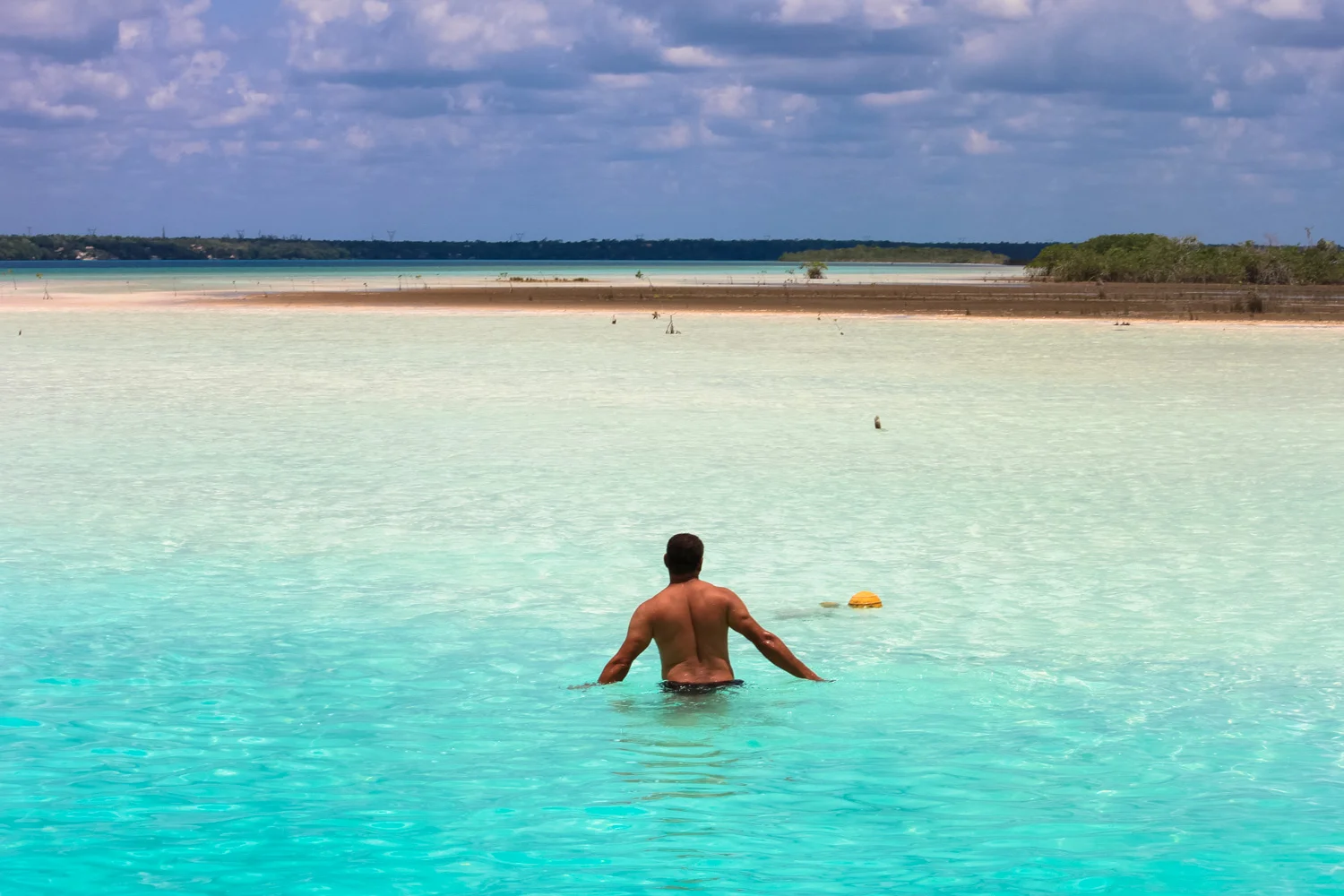
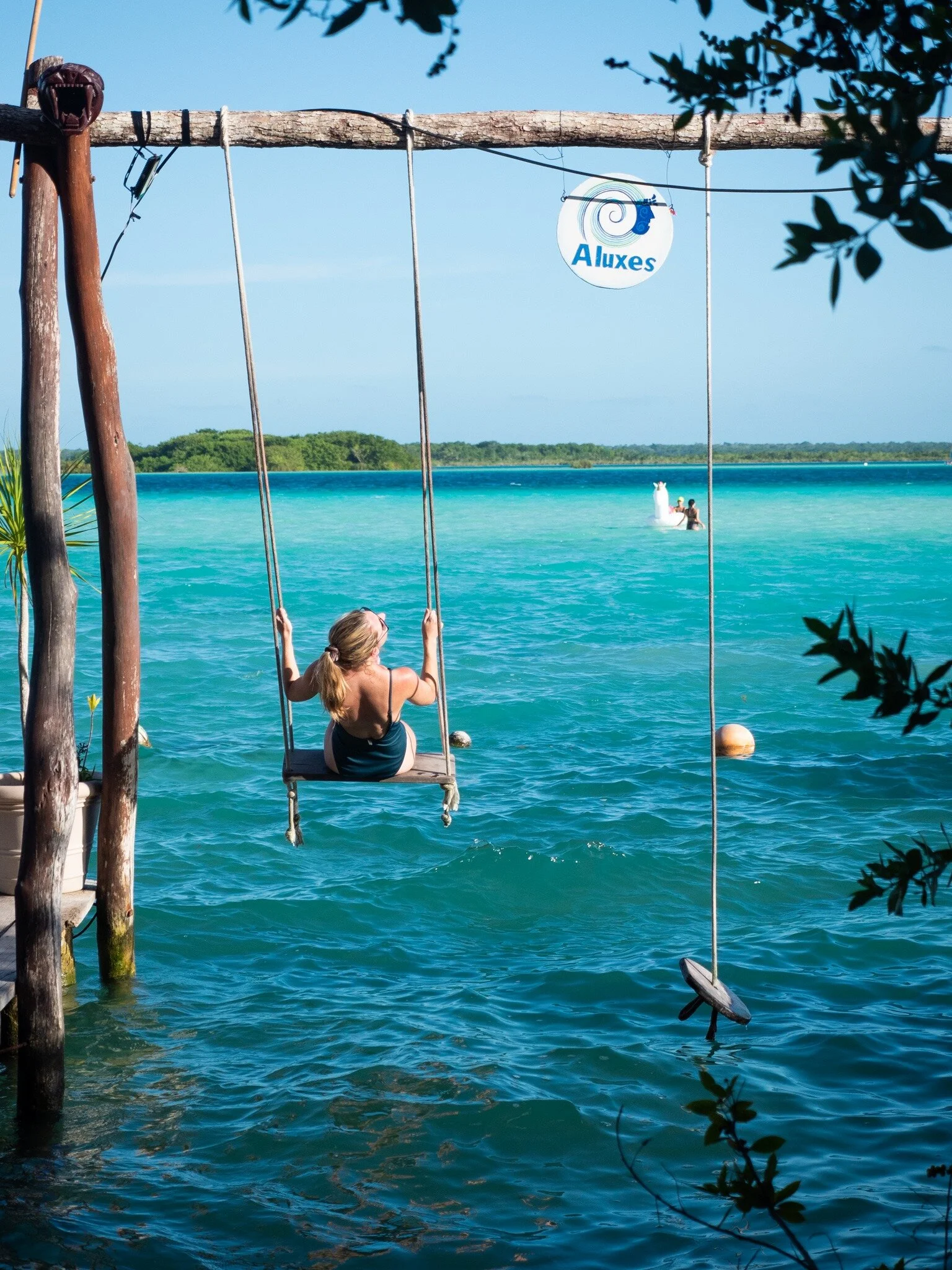
After a three hour drive from Tulum to Bacalar, we arrived in Bacalar and were immediately greeted by the sight if the lagoon. Laguna Bacalar is called the Lagoon of 7 Colours because of the distinct blue colours that are visible throughout the lake. The water clarity is also very impressive partly due to its white limestone bottom.
The lagoon measures 43 km long and 2 km at its widest point. It is also the second largest body of freshwater in Mexico, after Lago de Chapala in Jalisco and Michoacán.
There are several restaurants and bars located on the lakefront where you can have a meal or just a drink and sit lakeside or relax on the adjacent docks. There is one public dock that is free to access and is actually a lot of fun as well.
The lake is quite shallow at the shore except where there are cenotes. This makes it great for smaller children to get in and snorkel. Just be careful when jumping in!
You can rent a variety of equipment to get out into the water, including kayaks and sailboats but the best activity is a half day tour that gets you to all the different sites on the lagoon.
Lagoon tours
There are a few tour operators in town, some private and some that work as part of a cooperative. As you explore the town you will see signs everywhere advertising lake tours so you will have your pick of operators.
Lake tours are available next to the public dock that last for two hours and cost about $280 pesos.
After doing some research and because I was with my parents, I really wanted the best day out possible so we decided to go with the more expensive tour offered by Amir AdvenTours. The tour is in English and Spanish, goes for 3.5 hours and costs $526 pesos.
After meeting the guide and boat we crossed the Channel of the Pirates to take in the coastline from the water. From here you can see the Fort and all get a better sense of the 7 colours you can see throughout the lake.
We stopped in the channel for an explanation of the history of the lagoon and a quick swim in the warm waters. Amir then took the group for a walk through the sulfur infused muddy shallows for a full body mud mask followed by a fun race through the mud that really hugged your feet and if you were’t careful you could end up face first in the muddy water.
While we scrubbed the mud off Amir prepared a feast of tropical fruits including banana, watermelon, mango and the sweetest pineapple I’ve ever had.
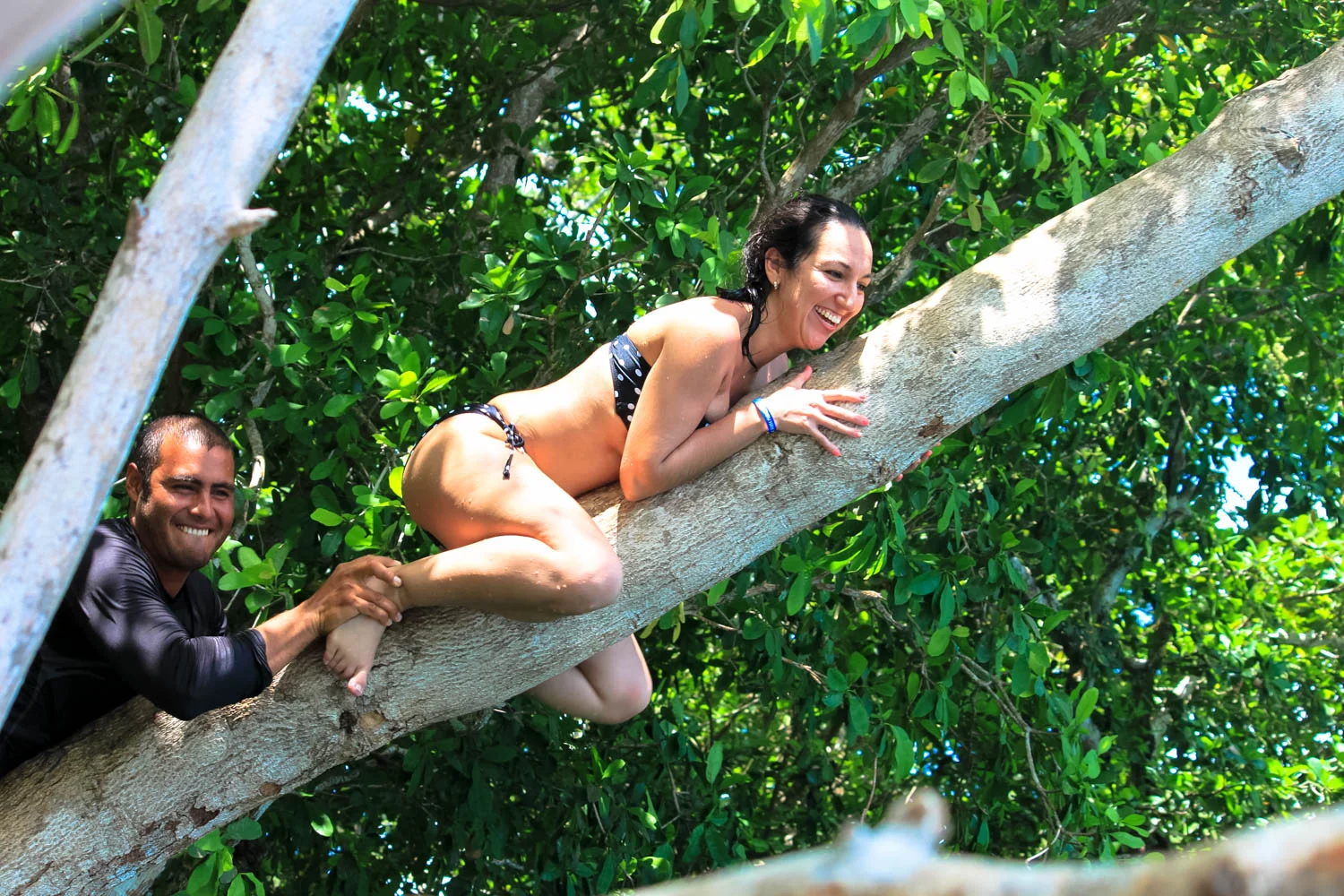
Amir even helped push us up the tree!
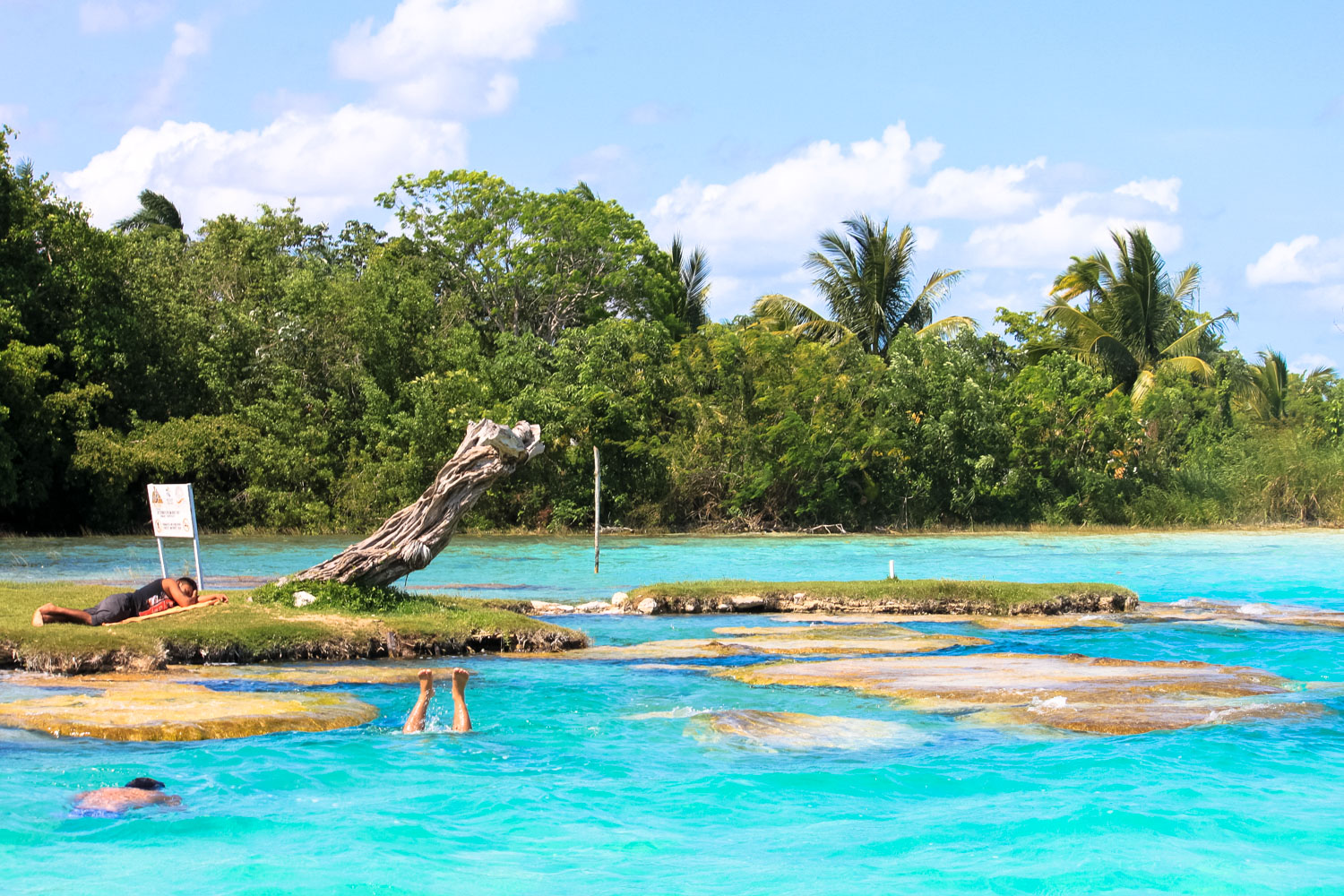
Hanging out at the stromatolites
After the snack stop we visited the “Black Cenote” which is an open cenote with a depth of about 85 meters where we got to snorkel. For the brave, Amir showed us how to do a dive after climbing the branches of a tree.
Then we visited the “Cenote Esmeralda” with a depth of 45 meters and finally the “Cenote Cocalitos” where you can see stromatolites that are known as living stones and are considered as the oldest form of life in the planet.
Finally, we visited the Island of Birds for one more swim and snorkel.
The tour includes snorkeling equipment, life jackets, fruit, snacks and drinks. There was a good balance of information and fun water activities and by the end of the tour we were pretty exhausted. I highly recommend this tour!
The Fort of San Felipe
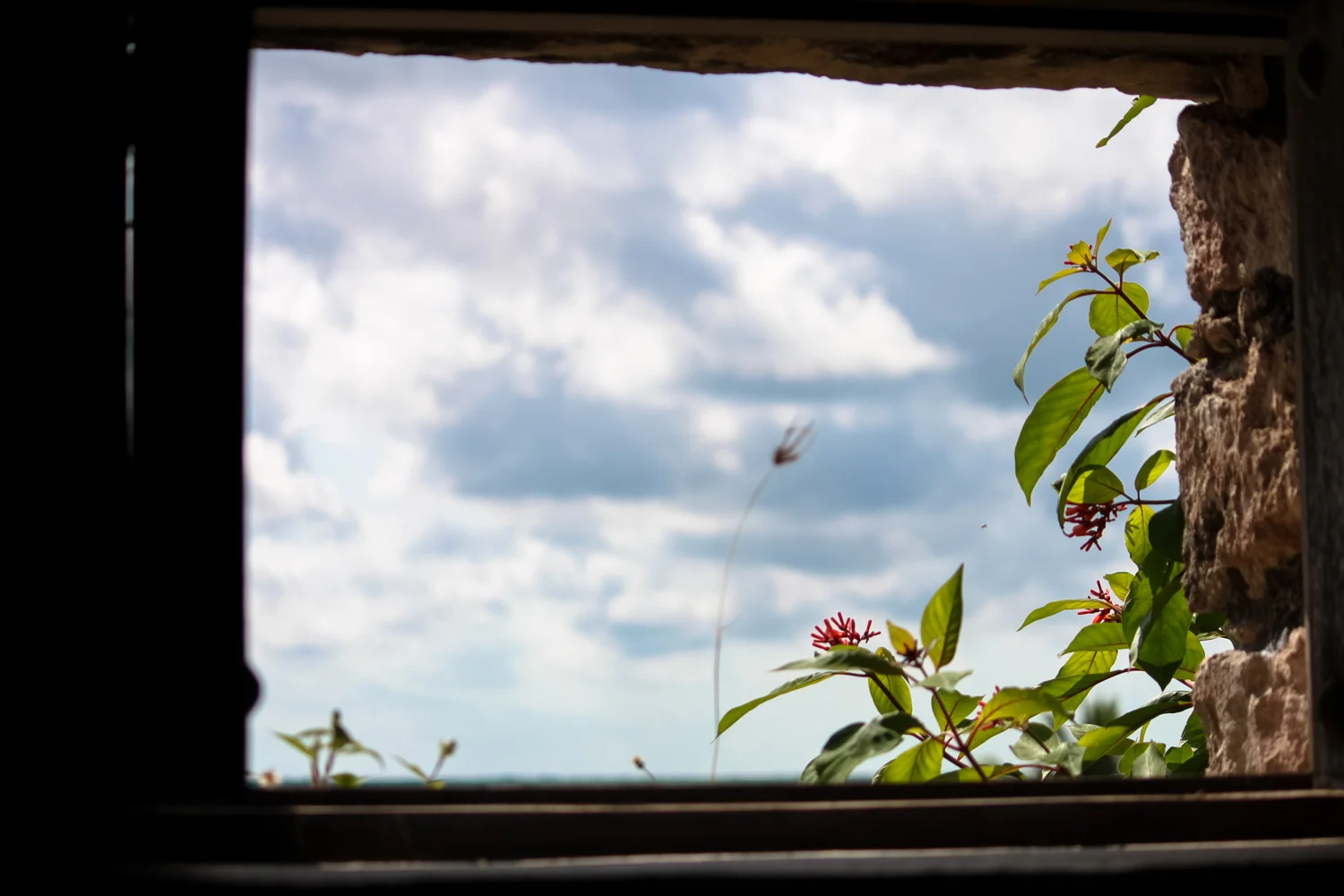
The Fort of San Felipe Bacalar is another major attraction in this area, because in its walls, pillars and ramparts there are still traces of past battles. The fort was built in 1729 with the main purpose of preventing the attacks suffered by the population from the pirates. Interestingly the fort was also used to monitor and repell traffickers of dyewood, a highly valued precious wood back then.
During the Caste War, the Fort was used by the Spanish as a point of defense against Maya who fought to win back the village, won the war but left the fort in ruins.
Today, the Fort of San Felipe Bacalar has become a local history museum. The collection in the museum includes pieces of pre-Hispanic history, Colonial history, drawings, historic plans, beautiful murals, multimedia devices and even the skeleton of a genuine pirate of the Caribbean.

Getting in and out
Bacalar is a great stopover in between the Yucatan and Belize. If you’re coming from Cancun it is a five hour drive or three hours from Tulum. There are regular ADO bus services if you’re not driving.

With it’s clear, warm waters and tranquil town, Bacalar is a great place to visit if you want to relax while taking in the stunning views the lagoon. These never got old and while relaxing on a dock with a good book, you could really waste a day or three away.
This post is part of my Top 30 in Central America and Mexico. You can also check out some more of my favourite sites and activities in Mexico here.

Have you made it to Bacalar? Any other recommendations for the region that I missed out? Let me know in the comments below!
You Might Also Like


Laguna De Apoyo - The Resort For Budget Travelers
Laguna de Apoyo is a crater lake said to be the result of Volcano Apoyo imploding on itself over 20,000 years ago. It is 48 square kilometres and the deepest point has been measured at 200 metres. It gets deep very quickly but is naturally warm and filled with volcano mineraly goodness. Like many beaches in Central America, the lake has a black sand beach.
While in Nicaragua I was desperate for a break from traveling for a few days. Long term traveling can take its toll if you try to pack too much in and at that stage I was feeling like I needed a holiday. I was indulging in some touristy pleasures in Granada when I learnt about a cool hostel that was supposedly like a resort for budget travelers at a small lake nearby. The dorms also had the best view of any dorm around the world! I booked myself onto the next shuttle.
You can go for the just the day or stay overnight. Once you arrive, there will be a staff member with a clip board to check you in. My group was separated into day trippers and over nighters and were led to the check in area. The hostel is very well run and I was checked in and shown to my bed within half an hour which is pretty great considering there was a lot of people waiting to check in.
I also noticed some travellers who had stayed the night and were hoping to book for longer! I did the same as soon as I saw the view and knew this was where I needed to be.
You’re given a token with an animal on it and this is what you use when ordering anything so they know what tab to put it on. The hostel is completely cash free until you check out! Which could be a good thing or a bad thing depending on how many $2 cocktails you clock up.

Rooms
Once I was taken down to the dorm I understood why it was so popular. I had heard that the view from the dorm was better than any other room and it was actually quite stunning. The dorm consisted of about 10 bunk beds and where the fourth wall should have been, there is just a large roller cage. This is great for keeping the room cool and also afforded spectacular views out to the lake. Dorms are just $10 a night!
There are also private rooms that are still quite affordable if you’re not into dorm life and everyone has access to all the resort facilities. A single room with shared bath is only $15 and you can get a double room with private bathroom for $32 a night.
If you’re traveling with a group they even have quadruple rooms! Check out their rates page for more information.
Day trips
The resort offers a day trip option which is great if you don’t have a lot of time but still want to experience lake life in Nicaragua. Day trippers can access all the facilities from 9 am to 5 pm at the cost of $7 per person. They also get free tea and coffee all day as well as access to restrooms and change rooms.
Eating and drinking
There are two spots where you can order and eat, upstairs near the check-in area has a great view of the lake and is more chilled out. A good spot for reading a book or getting lost in the view. The second and main area for eating is located right on the lake front. This is a more social spot where you can order your $2 mojito and take it right into the lake with you. No one’s judging here!

There’s a wood fire pizza oven and they do pizza nights a couple times a week. The pizza is actual some of the best I had while in Nicaragua so definitely give it a try while you’re visiting.
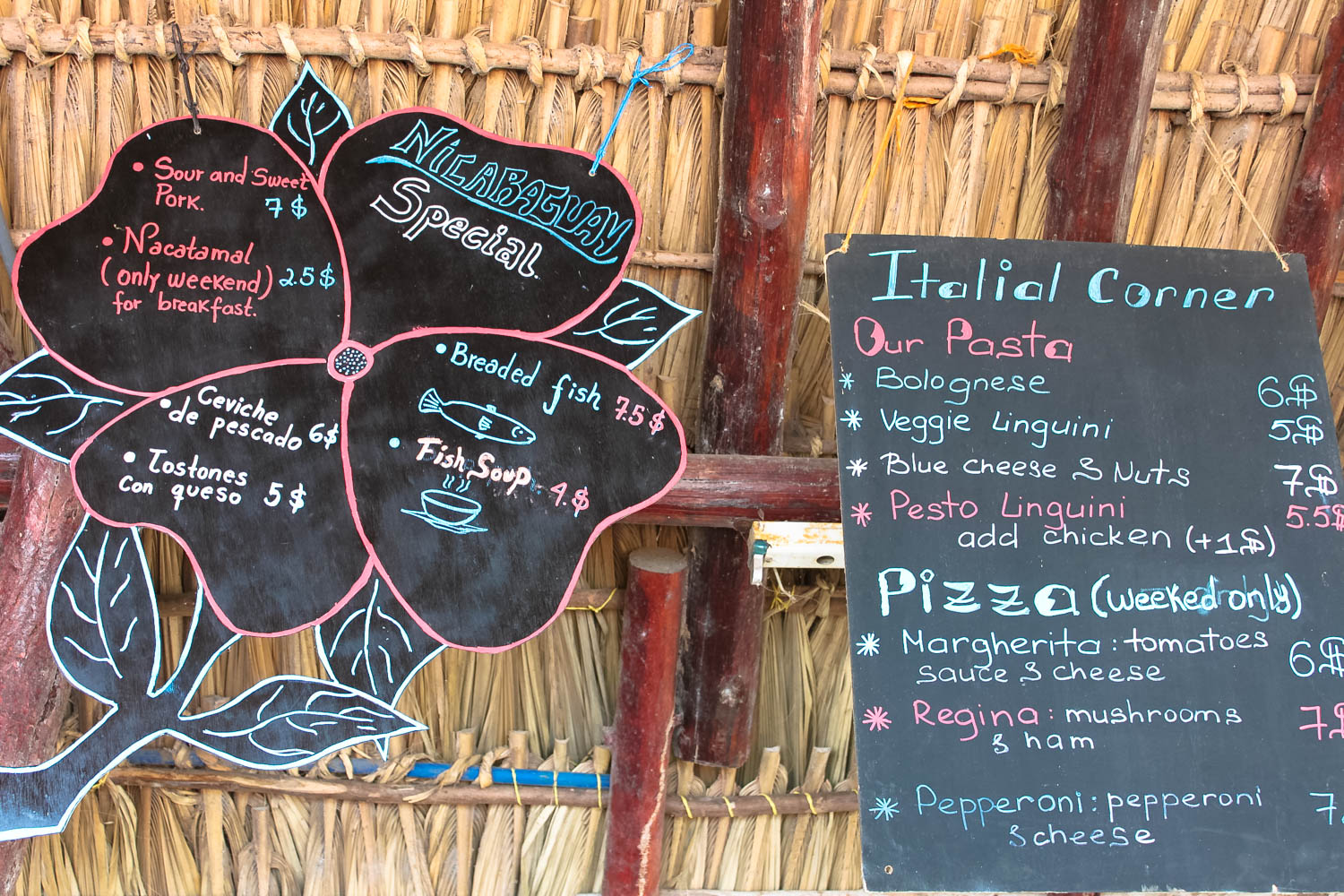
The menu is available to view online so check out all the awesome options. Meals range from typical Nicaraguan fare to more western treats, like my favourite the Blue Cheese and Walnut Linguine. Drool!
If you have any special dietary requirements you can confirm them with the staff before you arrive. Vegetarians and celiacs should be pretty comfortable here as I stayed 5 nights and didn’t feel like I was lacking variety.

Laguna de Apoyo
Apoyo Lake is a crater lake said to be the result of Volcano Apoyo imploding on itself over 20,000 years ago. It is 48 square kilometres and the deepest point has been measured at 200 metres. If you imagine the big cone that would have been left behind by the volcano you can get a good idea of the shape of the lake.
It gets deep very quickly but is naturally warm and filled with volcano mineraly goodness. Like many beaches in Central America, the lake has a black sand beach. This takes a little getting used to if you've never experienced it before.

Facilities
One of the best parts of Hostel Paradiso is their expansive grounds. It’s basically set into a slope (due to crater like shape described above) so there are lots of levels and lots of stairs. It’s worth taking 15 minutes to just explore the area to see what’s available. I mentioned to some friends that I was going to read my book on a hammock and they didn’t even know there was a hammock area!
There’s loads of water sports and other games available to occupy your time if you ever get bored of just lounging. These include: kayaks, stand up paddleboards, beach volleyball, beach badminton, pool, ping-pong, or traditional French boules.
There’s a chill out cabana with hammocks, couches and bean bags with a tv and dvd player. Great for rainy days!


There is a floating dock on the lake that you can swim to or grab one of the tires and float there in your own time. My top tip is grab a book or your kindle, wrap it in plastic bad or even better a zip lock bag and take it out to the deck. There is really nothing better than floating along on the dock with a good book.
I also enjoyed some night swims out to the floating dock with my new friends. Hanging out, sharing stories and laughing by moonlight in Apoyo is one of my most treasured travel memories.
There is wifi available but mostly on the very top level and sometimes in the reception area. Be prepared to be a bit off the grid, though, as the signal can be weak and cut out a couple of times while I was there. They’ve advertised recently that they have since doubled their bandwidth so you may be surprised!
The staff are super helpful and friendly. If you have any issues they were always happy to help. Especially the restaurant staff. They created a fun environment for all the guests.
I had a couple of friends who did the Spanish classes on offer and they really enjoyed it. The classes are in a cute little garden area on the property with lovely lake views so you still feel like you’re in paradise while doing your lessons
You can do single lessons or Paradiso offers a package deal if you want to stay for a few days and do lessons as well.


The lake and area
The best part of this hostel is the lake. It would be very easy to spend days lounging in a beach chair or floating along in an inner tube. The big surprise for me was that this is THE warmest lakes I have ever been in.
If you want to get out and explore the area there’s some great birdwatching and also monkey spotting. There are over 200 bird species that you can try to spot in Apoyo including 65 migratory species. Feel like getting out of bed early? Head out of the resort and to the right and you can certainly hear, if not see, the local howler monkeys.
There are also white-headed capuchins in the area, although, you would be very lucky to see those! On the Paradiso property I saw my first anteater in the wild so you should certainly keep your eyes open for all the wildlife that’s around.
There are several hikes to small towns in the area including Santa Catarina which has a flower and handicraft market and a stunning lookout where you can see the lake and Mombacho volcano.

Getting there and away
Paradiso has a shuttle that picks up traveler from different spots around Granada. It is $6 for a round trip and leaves around 10 am and 3pm every day, returning by 4 pm.
You can also catch a local bus heading to Masaya and ask to be let off at the entrance to Laguna de Apoyo. These buses leave from Granada every 10 minutes. The bus drops you at the entrance of the small town so you can either catch a taxi (100 cordobas aprox.) or walk for about an hour. Hitchhiking is also an option and you’ll see the locals doing it.
If there’s a couple of you, consider getting a taxi. You should be able to negotiate a fare for about $15 one way.

The important stuff
Paradiso Hostel
Email: paradisolaguna@hotmail.com
Phone: Mov: (505) 81874542 Claro: (505) 25203571
Skype: hostel.paradiso
Apoyo Tips
Make sure to book in advance
Bring enough cash with you for your whole stay
Try the tipico for breakfast - so good!
Meals range from $3.50 to $10
There are smoothies on the menu and you can add a shot of rum for $1 >.<
If you’re traveling during the off season (September and October) they have discounted rates for longer stays
Try to get up for at least one sunrise, they're amazing over the lake

After 10 years of travel in Central America, I finally made it to Belize, my elusive last country. Here are my very first impressions after spending a few weeks there.